
Exploring the Role of HDPE Pipes in Irrigation and Agriculture
Irrigation systems have developed over the years to supply water requirements not satisfied by rainfall, while minimising losses from run-off, evaporation, and leaks. Center-pivot systems that once used large, mounted spray guns now use evenly spaced spray heads positioned just above the crop to reduce evaporation. Flood irrigation has given way to sub-irrigation and drip irrigation, applying water near the root zone through buried perforated pipe or emitters rather than flooding entire fields.
Water is a valuable commodity and must be conserved, especially in arid regions. Just as irrigation methods have improved, so too has the pipe and tubing used to deliver water. At WL Plastics, our High-Density Polyethylene (HDPE) pipe has become the top choice for modern irrigation systems, and here we explain why.
Why Choose WL Plastics HDPE Pipe for Irrigation Projects?
Our HDPE pipe is the top material of choice for irrigation and well water systems because it performs reliably below ground and above ground, and is ductile, flexible, and long-lasting with a design life of over 100 years. Our pipe won't break with freezing temperatures or ground movement. Long coiled lengths up to IPS 6 reduce installation costs, and our HDPE pipe eliminates the water evaporation and seepage losses common in open canals. Being non-metallic, it won't corrode.
Above-Ground Use
Above-ground irrigation installation is much easier than buried installation and allows the system to be relocated as needed. Our HDPE pipe is well-suited to above-ground use because it is indefinitely UV-resistant, abrasion-resistant, ductile, and flexible. Drip irrigation is typically above ground, and our HDPE pipe and tubing are widely used in these systems. Unlike bell and spigot jointed pipe, our HDPE can be dragged from one field to another as irrigation needs change.
Our black HDPE pipe and tubing are protected indefinitely against UV degradation by well-dispersed carbon black content. Other plastic materials like PVC have minimal UV protection, making them susceptible to degradation that continues even when the pipe is removed from sunlight. Our HDPE remains ductile to temperatures below -100F and water can freeze inside it without causing harm or bursting. PVC, by contrast, is brittle at room temperature and becomes more brittle as temperatures drop. Our HDPE has an Izod Impact Resistance (ASTM D256) over 14 times greater than PVC.
Surge Resistance
With irrigation pumps continuously cycling on and off, surge resistance is critical. Our HDPE pipe is 250 times more resistant to cyclic surge fatigue than PVC and can handle continuous surge pressures of 150% over its rated pressure. PVC pipe pressure rating decreases as surge pressure increases.
Leak Resistance
Eliminating leaks in irrigation piping is a must for water conservation. Irrigation supply and lateral lines constructed with our HDPE pipe and properly joined with heat fusion do not leak. Heat fusion works because HDPE is a thermoplastic that can be repeatedly softened by heating and hardened by cooling. A PVC system constructed with rubber gasket bell and spigot joints and mechanical fittings has many potential leakage points, and with ground movement, PVC bell and spigot joints can pull apart in ways that our heat-fused HDPE simply will not.
Economic Solution
With our HDPE pipes' superior durability, toughness, and low resistance to flow, irrigation systems last longer and require less initial construction cost and less maintenance than traditional piping. Our HDPE piping does not need to be oversized to compensate for deteriorating flow capacity. The flexibility of our pipe allows for tight bending radii, eliminating the need for elbows, and its ductility removes the need for blocking at changes in direction as required by PVC pipe.
Flexibility and Ductility
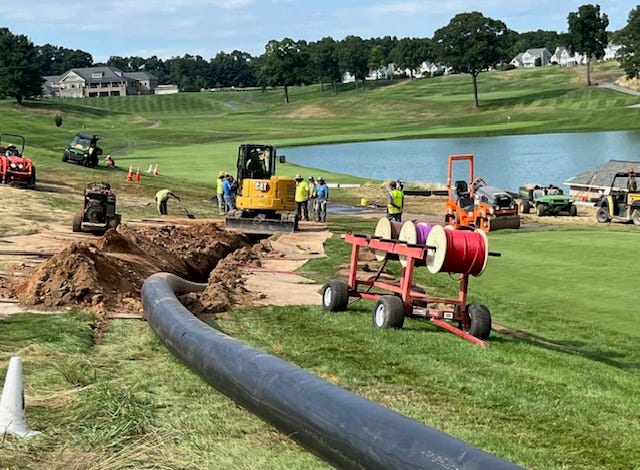
Our PE4710 HDPE pipe is the predominant pipe material used in the construction of new golf courses and in the rehabilitation of existing golf course irrigation and water systems. Because our HDPE is flexible, ductile, and abrasion-resistant, it is the top choice for trenchless installations such as horizontal direction drilling (HDD), pipe bursting, close-fit pipe lining, and insertion. HDD allows new pipes to be installed under congested and environmentally sensitive areas like lakes, fairways, wetlands, and roadways with minimal disturbance. Pipe bursting and insertion methods allow a new pipe to be installed along the same alignment as the pipe being replaced, with pipe bursting also allowing for upsizing.
Coil Lengths
Our coiled HDPE pipe is available in lengths up to 2,000ft, reducing installation costs by eliminating joints. Long coils make installing drip irrigation systems easier, with pipe and tubing cut to fit and fittings often eliminated entirely. A single length is also ideal for well casing and well pump piping.
Case Studies and Real-World Applications
Irrigation companies in the west, where water is scarce, have been replacing irrigation canals with our HDPE pipe to eliminate water losses from evaporation and seepage and to improve flow rates by removing the shrubs, trees, and algae that accumulate in open channels. The following are examples of successful projects using WL Plastics HDPE pipe.
Dry Gulch Irrigation Company, Roosevelt, Utah
The Hancock Lateral Pipeline replaced 21.2 miles of open canals with buried, pressurised HDPE pipe at a total project cost of $6.5 million. The pressurised system allowed over 3,000 acres of flood-irrigated land to convert to sprinklers without additional pumping equipment, with estimated pumping cost savings of close to $50,000 per year. By enclosing the open canals with our leak-tight HDPE pipe, Dry Gulch now delivers 30% more water than was previously lost to evaporation and ground seepage. Shareholders also gained an earlier start and a later finish to the growing season. Jim Young of Dry Gulch Irrigation said, "This is the first time we have used HDPE pipe. It is some really tough stuff."
Huntington-Cleveland Irrigation Company, Utah
HCIC provides irrigation, industrial, and municipal water to Emery County via open canals in use since the 1800s. Water moving through these canals picks up salt and contaminants, carrying them to the Colorado River Basin, where damages from high salinity are estimated at $750 million a year. A salinity grant under the American Recovery and Reinvestment Act of 2009 allowed HCIC to enclose 145 miles of the North Ditch Canal using our HDPE pipe. Before the project, only 25% of the water sent down the canal reached the crops. By replacing open canals with our HDPE pipe, HCIC eliminated water loss, increased maximum flow rate, and resolved the salinity issue. Project Manager Larry Perkins of J-U-B stated, "I don't think we could have done this project without HDPE pipe."
Grover's Hill Irrigation District, St. Johns, AZ
GHID replaced 5.5 miles of open irrigation ditch with buried 48-inch WL Plastics HDPE pipe. Degradation of the ditch through cracked lining, settlement, breakouts, invasive species, and flood damage had resulted in rising maintenance costs and increasing operational challenges. Our HDPE pipe eliminated these problems while increasing water delivery.
Three Sisters Irrigation District, Oregon
The canal systems in TSID were facing up to 50% water loss from seepage through the Deschutes National Forest. The district installed 3.77 miles of dual 54-inch WL Plastics HDPE pipeline from a diversion dam to the Watson Reservoir energy plant. Our HDPE system delivers 2,700 gallons per minute more water than the old canal while avoiding wildlife disruption and providing central Oregon with a greener future.
Nephi Irrigation Company, Nephi, UT
The Nephi Irrigation Company replaced 2,400 feet of ditch with 48-inch WL Plastics HDPE pipe to eliminate excessive water loss from their existing ditch irrigation system. Our HDPE pipeline significantly improved system efficiency and eliminated water loss to evaporation and surrounding soil.
Swalley Irrigation District, Oregon
For the last century, the district relied on open canals to deliver water from the Deschutes River. Since 2020, Swalley has been replacing its canals with our HDPE piping to save water and protect surrounding habitats. The first project, the Rogers Lateral Pipeline, cost roughly $2.6 million and replaced 3 miles of leaky, high-maintenance canal with a 24-inch WL Plastics HDPE pressure pipeline.
Conclusion
At WL Plastics, we provide reliable and durable HDPE piping solutions for irrigation and water well systems. Whether you're working on a small-scale agricultural project, a golf course renovation, or a large-scale water conveyance system, our PE4710 HDPE pipe offers the performance, flexibility, and longevity your operation demands. Say goodbye to leaks, corrosion, and maintenance headaches and trust WL Plastics for all your irrigation needs.
Looking for reliable and sustainable irrigation piping solutions? Contact WL Plastics today to learn more about our HDPE pipes designed for agriculture and irrigation.