
Why MDPE and HDPE Pipe Are Replacing Metallic Gas Distribution Mains and Services
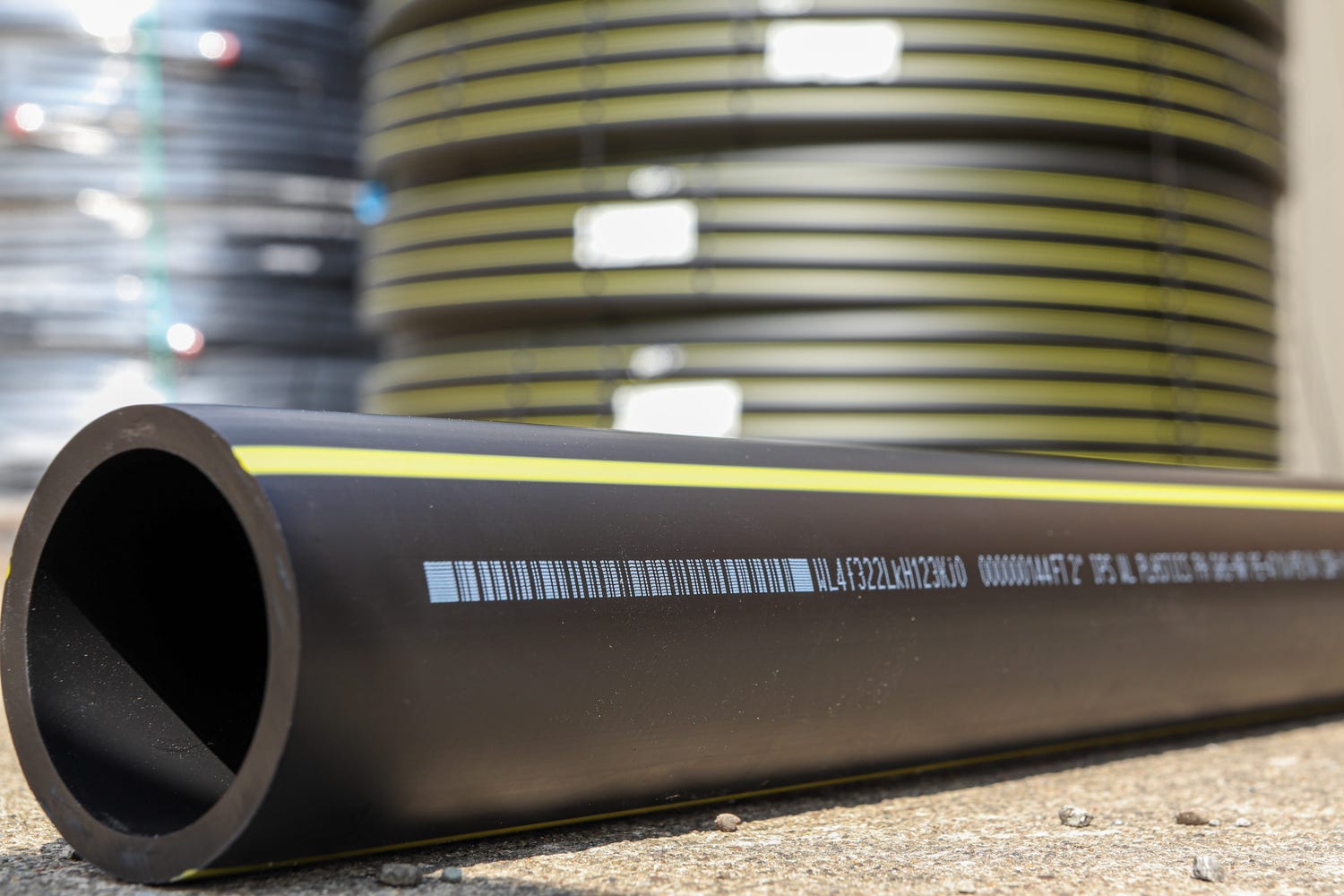
Polyethylene pipe has been the preferred material to modernize natural gas distribution systems across North America since the 1970’s. Historically, utility operators relied on metallic materials such as cast iron, wrought iron, copper, and bare steel to transport natural gas through distribution mains and service lines. This aging metallic infrastructure continues to be replaced bymedium-density polyethylene (MDPE) and high-density polyethylene (HDPE) pipe.
Annual reporting for natural gas distribution systems has been required since 1970 when the U.S. Department of Transportation (DOT) introduced 49 CFR Part 192, Transportation of Natural and Other Gas by Pipeline: Minimum Federal Safety Standards. Annual summaries published by the Pipeline and Hazardous Materials Safety Administration (PHMSA) show a clear and ongoing trend: polyethylene pipe is steadily replacing metallic pipe materials throughout the natural gas distribution industry.
As shown in Table 1, plastic gas distribution mains increased from 52% of total installed mains in 2010 to 63% in 2025. During the same period, metallic mains declined from 48% to 37% of total installed mileage. Similar trends can be seen with gas service lines. Table 2 demonstrates that plastic services increased from 67% to 79% of total installed services between 2010 and 2025, while metallic services fell from 30% to 19%.
This continued growth reflects the industry's confidence in MDPE and HDPE pipe for natural gas distribution. Polyethylene pipe is increasingly used to replace aging metallic infrastructure while also serving as the preferred material for new construction projects. Its corrosion resistance, flexibility, ductility, leak-free heat fusion joints, and ease of installation make it an ideal solution for modern gas utility networks. WL Plastics' gas distribution solutions highlight these long-term performance benefits, together with compliance to relevant industry standards and regulations
Table 1 – PHMSA Annual Reporting Summary- Miles of Gas Distribution Mains
(Source: https://www.phmsa.dot.gov/data-and-statistics/pipeline/pipeline-mileage-and-facilities)
| Report Year | Steel | Iron | Copper | Other | Plastic | Total Mileage | %Plastic | %Metallic |
| 2025 | 502,340 | 14,078 | 2 | 966 | 876,730 | 1,394,116 | 63% | 37% |
| 2024 | 506,143 | 15,059 | 3 | 1,183 | 857,349 | 1,379,737 | 62% | 38% |
| 2023 | 509,033 | 16,337 | 5 | 1,235 | 841,304 | 1,367,913 | 62% | 38% |
| 2022 | 512,820 | 17,491 | 5 | 1,207 | 824,981 | 1,356,505 | 61% | 39% |
| 2021 | 515,462 | 18,814 | 6 | 1,245 | 805,746 | 1,341,273 | 60% | 40% |
| 2020 | 519,233 | 20,447 | 8 | 1,299 | 788,860 | 1,329,848 | 59% | 41% |
| 2019 | 523,474 | 21,794 | 11 | 1,317 | 772,869 | 1,319,465 | 59% | 41% |
| 2018 | 527,664 | 23,394 | 12 | 1,314 | 755,827 | 1,308,211 | 58% | 42% |
| 2017 | 531,589 | 25,030 | 15 | 1,343 | 739,235 | 1,297,212 | 57% | 43% |
| 2016 | 536,042 | 26,769 | 16 | 1,361 | 721,563 | 1,285,752 | 56% | 44% |
| 2015 | 539,517 | 28,360 | 17 | 1,277 | 706,390 | 1,275,561 | 55% | 45% |
| 2014 | 545,104 | 29,984 | 20 | 932 | 690,416 | 1,266,456 | 55% | 45% |
| 2013 | 547,538 | 31,576 | 24 | 1,023 | 675,289 | 1,255,451 | 54% | 46% |
| 2012 | 551,477 | 33,136 | 25 | 1,018 | 662,169 | 1,247,826 | 53% | 47% |
| 2011 | 553,939 | 34,419 | 30 | 931 | 649,958 | 1,239,278 | 52% | 47% |
| 2010 | 556,241 | 35,376 | 31 | 812 | 637,481 | 1,229,941 | 52% | 48% |
Table 2 –PHMSA Annual Reporting Summary - Miles of Gas Distribution Services
(Source: https://www.phmsa.dot.gov/data-and-statistics/pipeline/pipeline-mileage-and-facilities)
| Report Year | Steel | Iron | Copper | Other | Plastic | Total | %Plastic | %Metallic |
| 2025 | 182,368 | 67 | 6,825 | 23,032 | 791,567 | 1,003,860 | 79% | 19% |
| 2024 | 184,400 | 89 | 6,955 | 24,318 | 776,588 | 992,351 | 78% | 19% |
| 2023 | 186,807 | 84 | 7,208 | 25,051 | 763,161 | 982,310 | 78% | 20% |
| 2022 | 188,425 | 76 | 7,559 | 25,587 | 743,665 | 965,313 | 77% | 20% |
| 2021 | 193,673 | 85 | 8,189 | 26,763 | 730,033 | 958,742 | 76% | 21% |
| 2020 | 199,671 | 91 | 9,425 | 27,038 | 718,612 | 954,837 | 75% | 22% |
| 2019 | 204,909 | 101 | 8,802 | 27,946 | 703,262 | 945,020 | 74% | 23% |
| 2018 | 211,277 | 87 | 9,378 | 21,956 | 688,248 | 930,946 | 74% | 24% |
| 2017 | 218,438 | 96 | 10,204 | 22,408 | 677,784 | 928,930 | 73% | 25% |
| 2016 | 226,693 | 121 | 10,927 | 21,808 | 666,196 | 925,745 | 72% | 26% |
| 2015 | 229,174 | 131 | 11,481 | 23,031 | 650,893 | 914,709 | 71% | 26% |
| 2014 | 233,532 | 152 | 12,105 | 19,751 | 637,379 | 902,919 | 71% | 27% |
| 2013 | 237,728 | 168 | 12,464 | 20,039 | 623,969 | 894,369 | 70% | 28% |
| 2012 | 243,806 | 187 | 12,882 | 20,443 | 613,144 | 890,462 | 69% | 29% |
| 2011 | 248,303 | 214 | 13,522 | 21,472 | 598,519 | 882,031 | 68% | 30% |
| 2010 | 249,380 | 227 | 13,804 | 22,619 | 586,503 | 872,533 | 67% | 30% |
Pipeline transportation remains one of the safest and most cost-effective methods of delivering natural gas and hazardous liquids throughout the United States. As energy demands continue to grow, the need to modernise and strengthen aging infrastructure has become a major priority for regulators and utility operators.
In response to several significant natural gas incidents, the U.S. Department of Transportation (DOT) and the Pipeline and Hazardous Materials Safety Administration (PHMSA) issued a Call to Action in 2011 aimed at accelerating the repair, rehabilitation, and replacement of high-risk pipeline assets. Pipeline age and material type were identified as key risk factors, with cast iron, wrought iron, and bare steel pipelines recognised as some of the highest-risk components still operating within gas distribution systems.
Many cast and wrought iron pipelines currently in service were originally installed during the late nineteenth and early twentieth centuries to support manufactured gas distribution networks. Although many of these systems continue to operate today, their age and material characteristics make them increasingly susceptible to deterioration and leakage.
Bare steel pipelines present similar long-term challenges. While many have already been replaced, some legacy systems remain in operation. The absence of protective coatings, combined with decades of environmental exposure, can significantly increase the likelihood of corrosion and gas leakage, making these assets prime candidates for accelerated replacement programmes.
The degrading nature of iron alloys, the aging process itself, and the design of historic pipe joint systems all contribute to elevated operational risk. Recognising these concerns, the Pipeline Safety, Regulatory Certainty, and Job Creation Act of 2011 directed PHMSA to conduct a state-by-state review of cast iron replacement progress across the United States.
These programmes have delivered measurable results. Between 1983 and 2025, cast and wrought iron gas distribution main mileage declined by approximately 79%, falling from 65,907 miles to just 14,078 miles. Twenty-four states and one U.S. territory have now completely eliminated cast or wrought iron natural gas distribution lines from their networks.
While the amount of cast iron pipeline continues to decrease, recent incidents demonstrate why replacement programmes remain a critical priority for gas utilities.
PHMSA regulations require operators to submit incident reports when gas leaks result in fatalities or injuries, property damage exceeding regulatory thresholds, or the release of significant volumes of natural gas. Analysis of gas distribution incidents reported between 2005 and 2025 highlights the disproportionate risk associated with cast and wrought iron infrastructure.
Key findings include:
- Eight percent of all gas distribution main incidents involved cast iron mains, despite cast iron representing only one percent of installed distribution mains.
- Thirty-eight percent of cast and wrought iron incidents resulted in injury or fatality, compared to nineteen percent of incidents involving other pipe materials.
- Thirty-three percent of all fatalities and fifteen percent of all injuries on gas distribution mains involved cast or wrought iron pipeline systems.
These statistics continue to reinforce the importance of pipeline replacement programmes focused on removing aging metallic infrastructure from natural gas distribution networks.
Understanding the common causes of failure in metallic gas distribution systems explains why utilities continue to transition towards polyethylene pipe.
Earth Movement
Ground movement caused by excavation activity, seasonal frost heave, soil settlement, changing groundwater conditions, or seismic events can place stress on rigid cast iron pipe systems. These forces often impact pipe joints, increasing the likelihood of leakage.
Graphitisation
Graphitisation is a naturally occurring degradation process that affects cast iron over time. As the iron matrix deteriorates, the pipe becomes weaker and more susceptible to cracking. Depending on the severity of degradation, gas can escape through weakened joints or newly formed cracks in the pipe wall.
Joint Design Limitations
Historically, cast iron pipelines were connected using bell-and-spigot joints, while wrought iron systems commonly used threaded or compression couplings. Both joint designs are vulnerable to leakage as infrastructure ages.
Many cast iron systems originally transported manufactured gas, which naturally kept joint packing materials moist. As natural gas replaced manufactured gas throughout the twentieth century, these materials dried out and shrank, increasing the frequency of leaks. Although various repair methods have been developed, the underlying vulnerability of these joint systems remains.
Corrosion
Corrosion continues to be the primary cause of leaks in bare steel gas pipelines. Long-term exposure to moisture, soil conditions, and environmental contaminants gradually weakens pipe walls, resulting in increased maintenance requirements, higher operating costs, and greater risk of gas leakage.
MDPE and HDPE pipe have become the materials of choice for both replacing aging metallic infrastructure and constructing new natural gas distribution systems because they effectively eliminate many of the traditional causes of pipeline failure.
Unlike cast iron and steel, polyethylene pipe does not corrode. This provides significant long-term reliability benefits while reducing maintenance requirements throughout the service life of the system.
Both MDPE and HDPE are highly flexible and ductile materials, allowing them to accommodate ground movement and soil settlement without cracking or failing. This flexibility also helps protect distribution systems during seismic activity and other environmental stresses that would typically challenge more rigid pipe materials.
One of the most significant advantages of polyethylene gas pipe is the use of heat fusion joining technology. Heat-fused joints create a homogeneous connection that is as strong as the pipe itself, eliminating many of the leak risks associated with mechanical joints and couplings. WL Plastics highlights leak-free heat fusion joints as one of the primary reasons polyethylene has become the industry standard for natural gas distribution applications.
Modern polyethylene resins have also delivered significant improvements in long-term performance. Current MDPE and HDPE materials are highly resistant to slow crack growth, meaning that surface scratches, notches, or minor installation damage are unlikely to propagate into larger defects over time.
In addition, advanced HDPE materials such as PE4710 offer improved hydrostatic design basis (HDB), enhanced slow crack growth resistance, higher tensile strength, increased flow capacity, and greater resistance to rapid crack propagation compared with earlier polyethylene generations. These benefits provide utility operators with a durable, reliable, and cost-effective solution for future natural gas infrastructure projects.
The transition from metallic pipe to polyethylene pipe represents one of the most significant developments in modern natural gas distribution infrastructure. PHMSA data clearly demonstrates the growing adoption of plastic gas distribution mains and services as utility companies continue to replace aging cast iron and steel networks.
With corrosion resistance, leak-free heat fusion joints, flexibility under ground movement, exceptional durability, and proven long-term performance, MDPE and HDPE pipe provide a safer and more cost-effective alternative to traditional metallic materials.
As gas utilities continue investing in pipeline modernisation programmes across North America, polyethylene pipe is expected to remain the preferred solution for both gas distribution mains and service lines, helping operators improve safety, reduce maintenance requirements, and build more resilient natural gas networks for the future.